

The way a manufacturing site structures its shifts has a direct affect on three things that matter most to operations leaders: labour cost, production output, and compliance. Yet in many manufacturing environments, the shift pattern in use was inherited rather than chosen, designed for a different headcount, a different demand profile, or a different regulatory environment than the one the site operates in today. To ensure efficient processes and employee well-being, it is essential to align shift schedules with current business needs and the overall manufacturing schedule.
For shift-based manufacturing workforces, getting the schedule right is not a one-time exercise. It requires understanding the options available, how each performs under real production conditions, and what factors should drive the decision. This guide covers the most common manufacturing shift schedule examples in use today, with practical detail on how each works, what it suits, and where the compliance and operational considerations lie.
Common manufacturing shift schedules
4-On 4-Off (12-Hour Shifts)
How it works: Employees work four consecutive 12-hour shifts, either all days or all nights, followed by four consecutive days off. Four teams rotate to provide 24/7 coverage across all production hours. This is one of the most common manufacturing shift patterns, offering round-the-clock coverage and balancing operational efficiency with employee rest.
Hours per cycle: Approximately 42 hours per week on average across the rotation.
Teams required: 4
Example rotation (Team A): 4 days on (06:00–18:00), 4 days off, 4 nights on (18:00–06:00), 4 days off. Teams B, C and D follow the same cycle, each offset by four days.
Best suited to: High-volume continuous manufacturing operations, like automotive assembly, food and beverage processing, plastics, packaging, where consistent round-the-clock coverage is non-negotiable. The four consecutive days off is the most valued aspect of this pattern for employees, which helps with retention and employee satisfaction in physically demanding shift environments. It is one of the most widely used 24/7 patterns in UK manufacturing.
Compliance consideration: 12-hour shifts are permitted under the Working Time Directive, provided average weekly hours do not exceed 48 across the 17-week reference period. Night workers are subject to health assessment requirements. Fatigue risk is concentrated in the consecutive night shift block and should be formally assessed.
Pitman Schedule (2-3-2, 12-Hour Shifts)
How it works: A two-week rotating cycle. Week one: work 2 days, 2 days off, 3 days on. Week two: 2 days off, 2 days on, 3 days off. Four teams rotate to maintain 24/7 coverage throughout.
Hours per cycle: Approximately 42 hours per week on average.
Teams required: 4
Example rotation (Team A): Week 1: Mon–Tue on, Wed–Thu off, Fri–Sat–Sun on. Week 2 : Mon–Tue off, Wed–Thu on, Fri–Sat–Sun off. The pattern then repeats.
Best suited to: Manufacturing sites where predictable, alternating long weekends matter to the workforce. The two-week cycle is easy to communicate and straightforward to plan around, making it well-suited to environments where schedule transparency is a priority alongside 24/7 coverage. It works particularly well on sites with strong employee representation, where the fairness of weekend shift distribution is a priority
Compliance consideration: The mix of short and long work blocks within the cycle should be reviewed against any applicable union agreements. The alternating weekend structure distributes weekend working across all four teams reasonably equitably, which is often a requirement in collective agreements.
DuPont Schedule (12-Hour Shifts, 4-Week Cycle)
How it works: The DuPont schedule is a rotating schedule that operates over a four-week period using 12-hour shifts. The schedule runs as follows: Week 1: 4 night shifts. Week 2: 3 days off, 3 day shifts, 1 day off. Week 3: 3 night shifts, 3 days off. Week 4: 4 day shifts, followed by 7 consecutive days off. Four teams cover all hours across the cycle, ensuring consistent coverage and regular rotation for employees working these shifts.
Hours per cycle: Approximately 42 hours per week on average.
Teams required: 4
Best suited to: Large, complex continuous manufacturing operations in chemicals, metals, heavy industry and energy, where the built-in seven-consecutive-day break is a genuine operational feature used for workforce recovery, training blocks, and planned maintenance windows. The DuPont schedule is well-established in unionised environments because the structured four-week rotation is transparent, auditable, and demonstrably fair across all teams.
Compliance consideration: The seven-day break provides a natural buffer for rest period compliance. However, four consecutive 12-hour night shifts in week one carry documented fatigue risk, particularly for workers in physically demanding production roles. Fatigue assessments should be documented and reviewed regularly.
Continental Shift (8-Hour Rotating Shifts)
How it works: A rotating three-shift pattern, which is, morning, afternoon (often referred to as the swing shift), and night, that cycles across a defined period. The swing shift typically covers the afternoon or late evening hours within the rotation, spanning from the afternoon into early morning. A common structure runs two days on each shift before rotating: 2 morning shifts, 2 swing (afternoon) shifts, 2 night shifts, then 2 days off. Three or four teams cover all 24 hours.
Hours per cycle: Approximately 40 hours per week on average.
Teams required: 3–4
Best suited to: Manufacturing environments where 24/7 coverage is essential but where workforce profile, health considerations, or union preference makes 12-hour shifts unsuitable. Eight-hour shifts are less physically demanding, and forward rotation. For example, morning to afternoon (swing shift) to night, is significantly less disruptive to circadian rhythms than backward rotation. This pattern is common in automotive, textiles, ceramics, and process manufacturing, particularly on sites with a mixed-age or older workforce.
Compliance consideration: Eight-hour shifts present fewer fatigue-related compliance risks than 12-hour schedules as a baseline, but the frequent rotation of shift times carries its own sleep disruption risk. Forward-rotating schedules are strongly preferable and should be specified explicitly in any shift pattern documentation or workforce agreement.
Panama Schedule (2-2-3, 12-Hour Shifts)
How it works: A two-week rotating cycle using 12-hour shifts across four teams. The pattern runs: 2 days on, 2 days off, 3 days on, then repeats in the second week as 2 days off, 2 days on, 3 days off. Teams typically remain on fixed day or night shifts for one week before rotating to the opposite shift the following week, ensuring continuous operations with fewer staff.
Hours per cycle: Approximately 42 hours per week on average.
Teams required: 4
Best suited to: Continuous plant operations, process manufacturing, utilities, chemicals, and sites that cannot be shut down, where the priority is consistent, predictable coverage with regular time off. Every employee in a Panama schedule receives at least one full weekend off in every two-week cycle, which is valued on sites where weekend working has historically been a source of workforce friction. Compressed workweeks can reduce turnover by up to 20%.
Compliance consideration: The pattern should be reviewed against any contractual provisions on weekend working frequency. In heavily unionised manufacturing environments, the distribution of weekend shifts across teams should be clearly documented and demonstrably fair across all four teams over a full rotation cycle.
3-Shift 5-Day (8-Hour Shifts)
How it works: Three eight-hour shifts cover a 24-hour production day, Monday to Friday. Three teams rotate through morning (06:00–14:00), afternoon (14:00–22:00) and night (22:00–06:00) shifts each week. The site either does not operate at weekends or runs on a reduced or maintenance staffing model.
Hours per cycle: Approximately 40 hours per week.
Teams required: 3
Best suited to: Manufacturing operations that do not require continuous 24/7 coverage, such as discrete manufacturing, batch production, food production with weekend cleaning and maintenance windows, or any site where production demand is concentrated in the working week. This is the most straightforward pattern to administer and suits smaller sites, or operations where a weekend break is part of the planned production cycle rather than a gap in coverage. Employees working fixed shifts benefit from high predictability and stability, which can enhance employee satisfaction.
Compliance consideration: The five-day structure is the most straightforward from a Working Time Directive perspective. Night shift provisions still apply to the 22:00–06:00 team, including health assessments and maximum night working hour limits. This is often overlooked on sites that treat the night shift as a secondary operational concern.
Labor Laws and Compliance in Manufacturing Shift Scheduling
In the manufacturing industry, effective shift scheduling is not just about meeting production demand, it’s also about ensuring every shift pattern complies with a complex labor laws, local and state regulations, and union agreements. For plant managers, this means that every decision about shift schedules, from rotating shift patterns to night shifts, must be made with compliance at the forefront.
Rotating shift schedules, where employees consistently switch between day and night shifts, are common in manufacturing businesses that operate around the clock. However, these schedules bring unique compliance challenges. Labor laws require that employees receive enough rest periods between shifts to protect their health and maintain a reasonable work-life balance. For example, regulations such as the Working Time Directive mandate minimum rest breaks and limit the number of hours employees can work within a given period.
Managing these requirements manually can be overwhelming, especially in environments with four teams rotating through a four-week cycle or where production needs fluctuate. This is where manufacturing employee scheduling software and workforce management software become essential tools. These platforms automate the scheduling process, allowing plant managers to create custom rules and shift templates that reflect both business requirements and compliance rules. With real-time visibility into staffing levels, employee availability, and shift coverage, managers can assign shifts efficiently, avoid unnecessary overtime, and ensure that all employees receive fair treatment.
How to Choose the Right Manufacturing Shift Schedule
There is no universal answer to choosing the right manufacturing shift schedule. The right structure depends on a combination of operational, workforce, and regulatory factors specific to each site. And the best outcomes come from evaluating all of them together, rather than simply choosing the pattern that’s most familiar. Ultimately, the right manufacturing shift schedule should align with your business needs and staff availability to ensure both operational efficiency and employee satisfaction.
Why Manual Shift Scheduling Creates Operational Risk in Manufacturing
Selecting the right shift pattern is only part of the challenge. Companies also have to then manage that pattern day-to-day across a real production environment: tracking who is available and certified, ensuring every shift has the right skills coverage, responding to absences before they become production problems, and doing all of this within Working Time Directive limits, union agreement constraints, and site-specific certification requirements.
For smaller operations running a stable 3-shift 5-day model with consistent, experienced teams, manual scheduling can be manageable. But as soon as a manufacturing site introduces rotating shifts, multiple production lines, skills-based assignment, or significant headcount, manual processes begin to create potential risks. Accurate tracking is essential for compliance with regulations and operational efficiency, but manual methods often fall short, leading to errors and missed requirements.


A spreadsheet cannot automatically check that the employee covering a vacancy holds the required certification for that production line. It cannot alert a planner that assigning an additional shift to a specific worker would breach their weekly hours limit. It cannot update a rota instantly across all affected teams when an absence is called in at 05:30 on a Monday. And it cannot give a plant manager live visibility of actual versus planned labour cost across three sites simultaneously.
This is the daily operational reality of managing a shift-based manufacturing workforce at scale. When manual scheduling breaks down, the consequences are unplanned overtime, compliance exposures that surface only after the fact, and supervisors spending their time on administration rather than production management.
Manufacturing rostering software addresses these problems directly by automating compliance validation, skills-based assignment, absence management, and labour cost tracking within a single system. Employee scheduling software can also help manage labor costs and improve communication within teams, making work schedules more transparent and efficient. The shift pattern provides the structure; the software makes it operational, compliant, and sustainable at scale.
See manufacturing rostering software
in action
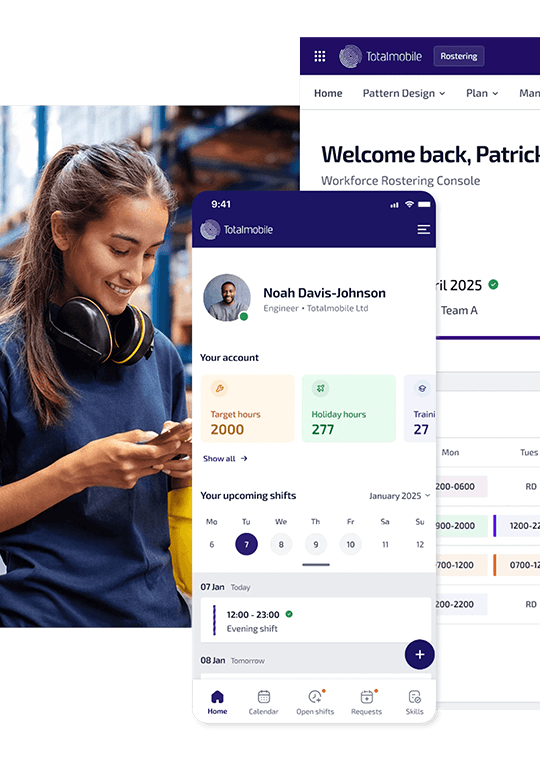
Totalmobile’s workforce rostering solution is built for shift-based manufacturing organisations that need to align labour capacity with production demand – automatically, compliantly, and at scale.